
The History of Industrial Lubrication & Pressol's Legacy | Odaksan
The History of Industrial Lubrication & Pressol's Legacy | Odaksan
A Thousand-Year War Against Friction: The History of Industrial Lubrication and the Legacy of Pressol
Human history is, in essence, the history of machinery and movement. However, every spinning wheel and every sliding surface brings along a relentless adversary by its very nature: friction. Behind the high-tech fluid transfer and lubrication systems we use in modern factories today lies a monumental heritage built on thousands of years of trial, error, and engineering mastery.
First Steps in the Ancient World: From Animal Fats to Lime Mixtures
The earliest archaeological evidence of lubrication traces back to Ancient Egypt. Wall paintings found in pharaoh tombs dating to 2400 BC clearly depict workers pouring liquid (water or primitive oils) in front of massive wooden sledges to reduce friction while transporting giant stone statues. Later, the Egyptians and Romans discovered that blending animal fats (tallow) with vegetable oils (olive oil) prevented wheel hubs from charring due to the heat generated by friction.
Historical records indicate that the Romans created the most primitive form of today's calcium-soap greases by mixing olive oil with lime (calcium oxide). The lime saponified the fatty acids, transforming the fluid oil into a thick, paste-like consistency capable of adhering to moving surfaces. Tribology (the science of friction) gained a true scientific identity during the Renaissance when Leonardo da Vinci calculated friction coefficients for the first time. Ultimately, with the petroleum revolution of the 19th century, lubrication became the absolute core of modern industrial operations.
A Turning Point in Lubrication: Jakob Pressl and the World's First Grease Gun
As machines grew larger and industrial production accelerated, delivering oil or grease deep into mechanical components and bearings without waste—under high pressure—became a major engineering challenge. It was during this period that an inventor stepped onto the stage to change the history of industrial lubrication forever: Jakob Pressl.
In 1910, Jakob Pressl, a German naval officer and inventor, developed a pump mechanism capable of injecting lubricating oils and grease into machinery in exact amounts under high pressure. This breakthrough went down in history as "the world's first hand-held grease gun," an instrument recognized as a global industry standard today. Jakob Pressl officially received the patent for this revolutionary mechanism in 1914.
A Global Giant is Born: The Foundations of Pressol
Inspired by Jakob Pressl's own surname, the Pressol brand began its journey, transforming from a small workshop into a global powerhouse backed by this unique patent. Over the following decades, the company evolved into an engineering hub that set the benchmark for all aspects of industrial fluid management—ranging from fluid measuring jugs to pneumatic pumps.
- Technological Heritage and Solutions: Throughout Pressol's development, heavy-duty, high-compression pneumatic systems were engineered to meet the intense lubrication demands of industrial plants. This heritage, combined with SRL (Self-Regulating Lubrication) concepts and high-performance fluid pump technologies, ensured that every single drop of grease was delivered to mechanical parts efficiently, leaving zero room for waste.
Today, this thousand-year war—spanning from primitive oils poured in front of Egyptian sledges to Pressol's millimetric, high-precision pneumatic grease pumps and fluid management systems—is the greatest guarantee for uninterrupted industrial production. As Odaksan, we are proud to deliver this deep-rooted lubrication legacy initiated by Jakob Pressl in 1910 directly to your facilities with state-of-the-art solutions.
OTHER BLOG POSTS
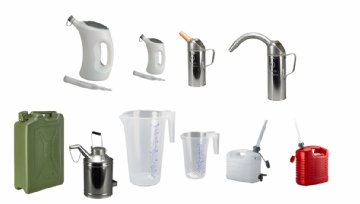
Pressol Graduated Measuring Jugs & Industrial Funnel Solutions
3.09.2026
Millimetric precision in industrial fluid transfer! Chemical-resistant Pressol graduated containers and chemical transfer funnel models are on our website with Odaksan assurance.

Odaksan & Zeca Spring Cable Reels: Safe Energy Management for Crane Systems
17.11.2025
A spring cable reel is a mechanism that allows a cable to unwind and rewind in sync with a crane’s movement. This prevents the cable from tangling, dragging, or being damaged.
Pneumatic Drum Oil Pumps: The Power Behind Industrial Lubrication
4.11.2025
In the industrial manufacturing world, every machine must run without interruption. When production stops, it’s not just the machines that halt—planning, operations, and delivery schedules also stall. That’s why lubrication in factories isn’t a side task; it’s the safety belt of production.